CHILD PROTECTION POLICY AND PROCEDURES
INTRODUCTION
The protection of children and young people from harm and mental or physical abuse is an absolute priority for ANVOB, its staff, directors, volunteers and anyone working on behalf of ANVOB such as work experience placement, external evaluator and others.
This policy outlines our commitment to and recognition of responsibility for the protection of the children and young people we work with. We recognise that the welfare and interests of children are paramount in all circumstances.
Children and young people are regarded as all persons under the age of 18. ANVOB recognises that persons aged 18 and over may also be vulnerable and, in some circumstances, may need similar protection appropriate to the guidelines in this policy.
We will endeavour to safeguard children and young people by:
- Adopting child protection guidelines through a code of behaviour for staff and volunteers.
- Ensuring directors, staff and volunteers take seriously all concerns and allegations of abuse and respond appropriately.
- Encouraging other organisations offering volunteer placements to young people to adopt policies and procedures that ensure the safety and the wellbeing of young people.
- Sharing information about child protection issues and good practice with young people, parents, staff and volunteers.
- Sharing information about child protection concerns with agencies ((e.g. Essex County Council Children Young People and Families or the Police) that need to know and involving children, young people and parents appropriately.
- Following carefully the agreed procedure for safe recruitment and selection of staff and volunteers involved in working with the children and young people.
- Providing effective management for staff and volunteers through supervision, support and training.
- Securely maintain and store confidential, detailed and accurate records of all safeguarding concerns.
- Ensure that robust safeguarding arrangements and procedures are in operation; and Address without delay any failure to comply with this policy.
- Review Child Protection Policy and Procedures annually.
WORKING WITH CHILDREN AND YOUNG PEOPLE
VAEF recognises that staff and volunteers working for the organisation are themselves vulnerable in their work with children and young people. The following aims to provide advice and guidance to help protect both children and young people and also ANVOB staff and volunteers working with children and young people, who may be vulnerable to allegations.
- Staff and volunteers should not spend time alone with children and young people away from others. Meetings and interviews with individual young people should take place as openly as possible. If privacy is needed, then a door should be left open and other staff and volunteers informed of the meeting.
- When working with groups of children and young people, staff and volunteers should ensure that staff to volunteer ratio is appropriate, with a recommended minimum ratio of 1 adult to 10 young people aged 14 to 18 for low-risk activities. Ratios should be reviewed as part of the risk assessment procedure for each new activity organised.
- Staff and volunteers are advised not to make unnecessary or inappropriate physical contact with children and young people. However, there may be occasions where physical contact is unavoidable. In all cases the physical contact should only take place with the consent of the child or young person and should be appropriate, ie kept to the extremities such as hands, head, shoulders as far as possible.
- For example, physical contact will normally be necessary when administering first aid to children and young people. If it is possible, first aid should be administered in the presence of another responsible adult. However, in such circumstances the safety and well being of the child or young person is paramount and the first aider should not allow the guidance within this policy to prevent the administration of treatment necessary to preserve life or deterioration of a serious condition.
- Any person that has found him or herself in a potentially vulnerable situation should report the circumstances to the ANVOB Child Protection Office or his/her Deputy.
- Staff and volunteers should not take children or young people alone in a car or mini bus on journeys, however short. In the event of a chaperone not being available ANVOB staff will not transport unaccompanied children and young adults.
- Staff and volunteers must obtain expressed written consent of parents/guardians and the permission of the Chief Officer or her Deputy Child Protection Officer before transporting groups of children and young people.
- Staff and volunteers should not meet with children and young people outside of organised activities unless it is with the knowledge and consent of parents/guardians and the Chief Officer or her Deputy Child Protection Officer. Copies of all individual communication with children and young people via letter and email should be easily accessible and available to the Chief Officer, the Deputy Child Protection Officer and the Admin Manager.
SHARING INFORMATION
ANVOB is committed to making information about the organisation, its activities and policies easily accessible to volunteers, parents, organisations and anyone else in contact with ANVOB.
When organising activities (including trips) for children and young people, we will:
- Provide information about the activity, any risks associated with it, our Child Protection policy and the name of the person to contact in the event of concerns or complaints.
- Gain any relevant consent, including consent for emergency medical treatment, from parent/guardians prior to starting the activity.
- Ensure that staff and volunteers know how to deal with emergencies and child protection issues.
PROCEDURES FOR REPORTING SUSPECTED ABUSE
The Board of Directors is responsible for nominating a director that, in addition to the ANVOB Chief Officer, will accept responsibility for matters of child protection in relation to the work of ANVOB. All matters related to child protection must be reported to the member that has senior responsibility for child protection (Child Protection Officer) or, in the case of their unavailability, to the second member with this responsibility (Deputy Child Protection Officer). All staff and volunteers will be made aware of whom these persons are and that they can contact the Child Protection Trustee directly if they have any concerns that they cannot raise with the Child Protection Officer or Deputy or are dissatisfied with the Child Protection Officer or Deputy response.
Should a child or young person disclose abuse:
- Try to move somewhere more private, ensuring you are not alone with the person.
- Listen to the child or young person rather than question him or her directly. Offer him or her reassurance without making promises (e.g. about keeping secrets).
- Never stop a child or young person who is freely recalling significant events.
- Remain calm
- Explain clearly what you have to do and whom you have to tell.
- Do not question or interrogate the child or young person.
- Record the discussion accurately, as soon as possible after the event.
- If there is fear of immediate risk or harm to the child or young person seek help from Police, Essex County Council Children Young People and Families or Medical Staff immediately that the child or young person has finished their disclosure. In any case, the Child Protection Officer must be contacted as soon as possible.
- The Child Protection Officer must make a record of the disclosure and act in the best interests of the child or young person, making a direct referral to Essex County Council Children Young People and Families Department if appropriate.
It is neither the right nor the role of staff, trustees and volunteers of ANVOB to presume innocence or guilt in relation to any disclosure.
DEFINITIONS OF ABUSE
Within this policy the following are regarded as abuse. However, it must be recognised that abuse may take many forms and may not always be obvious, they may include:
Neglect Physical abuse Sexual abuse Emotional abuse
Please note this is not an exhaustive list. Children can also be abused via the internet and other technology.
a) Neglect
This is defined under the Children Act 1989 as “The persistent or severe neglect of a child or the failure to protect a child from exposure to any kind of danger including cold or starvation. Failure to carry out important aspects of care resulting in the significant impairment of the child’s health or development, including non organic failure to thrive”.
The following may be possible signs that a child is suffering from neglect:
- Developmental delay
- Constant tiredness
- Constant hunger
- Poor personal hygiene
- Poor state of clothing
- Untreated medical conditions
- Low self esteem
- Poor social relationships
- Poor physical condition
- Obsessive/neurotic behaviour
- Compulsive stealing
- Unsanitary living conditions
b) Physical abuse
This is defined under the Children Act 1989 as “Actual physical injury to a child or failure to prevent physical injury or suffering including deliberate poisoning or suffocation”.
The following may be possible signs that a child or young person is suffering from physical abuse:
- Unexplained injuries or burns (particularly if recurrent)
- Feeble excuses or refusal to explain injuries
- Withdrawal from physical contact
- Abnormally hiding skin from sight
- Self harm tendencies
- Aggression towards others or extremely passive
c) Sexual abuse
This is defined under the Children Act 1989 as “The sexual exploitation of a child or adolescent or their involvement in inappropriate sexual activities.”
The following may be possible signs that a child or young person is suffering from sexual abuse:
- Extreme fear of a particular person
- Soreness/bleeding in the throat, genital or anal regions
- Inappropriately playing out sexual behaviour
- Talk about a friend who has a problem
- Deliberately lying and stealing to get caught
- Irrational changes in behaviour
- Drawing sexually explicit pictures that indicate abuse
- Nightmares
- Wetting themselves
- Feelings of being bad, dirty or wicked
- Acting in a sexually inappropriate way towards adults
- Hinting about secrets they can’t tell
d) Emotional abuse
This is defined under the Children Act 1989 as “Actual severe erase effect on emotional and behavioural development of a child caused by persistent or severe emotional ill treatment or rejection”.
The following may be possible signs that a child or young person is suffering from emotional abuse:
- Developmental delay
- Over reaction to mistakes
- Fear of new situations
- Self harm
- Compulsive stealing
- Fear of parents being contact
- Drug/solvent abuse
- Obsessive/neurotic behaviour
- Irrational changes in behaviour
PROCEDURE FOR REPORTING DISCLOSURES
- Please pass any initial concerns to the
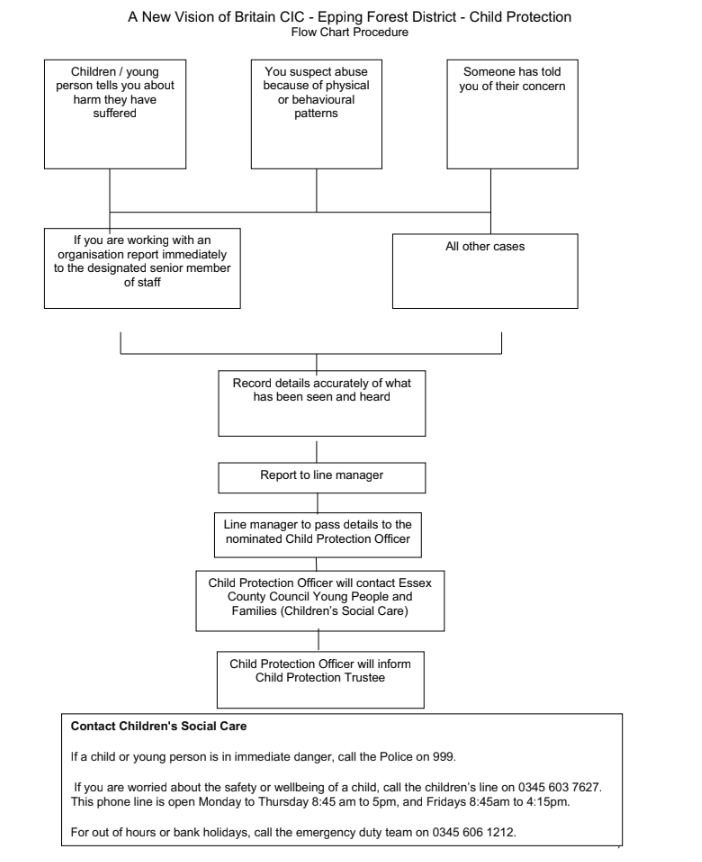
Child Protection Officer – Raymond Harris Chief Officer rharris06@yahoo.co.uk 07913 243577 or 07913 236673 Deputy Child Protection Liaison Officer – Nick Robinson, ANVOB Activities Coordinator nrobinson@vaef.org.uk 07967 726851
- A decision will be made by the CPO/DCPO to contact the Essex County Council Children Young People and Families
A flow chart has been added to this policy to assist staff to understand the procedure of reporting child protection issues.
RECRUITMENT AND SELECTION OF STAFF AND VOLUNTEERS
ANVOB recognises that, while most people wanting to work with children and young people are well motivated, it is important to have good recruitment and selection practices to help screen out those that are not suitable.
To this end we:
- Have clear job descriptions and person specifications for all paid and voluntary opportunities within the organisation.
- Ask all applicants to supply information in writing via an application form. This includes personal details, current work/volunteering experience, any qualifications or skills and a declaration of any, or no, past criminal record.
- Ask for evidence of identity (eg birth certificate).
- Obtain two written references.
- Meet with all applicants via formal or informal interviews.
- For those posts involving substantial unsupervised access to children and young people, carry out an appropriate check through the Disclosure and Barring Service (DBS), which would be an enhanced DBS check.
- DBS checks will also be carried out for staff and trustees that hold Children Protection responsibilities for the organisation.
MANAGEMENT AND SUPERVISION OF STAFF AND VOLUNTEERS
ANVOB’s commitment to children’s and young people’s safety includes ensuring that relevant staff and volunteers are supervised and supported in their work with children and young people. With this in mind:
- New staff and volunteers receive an induction that includes a familiarisation with the organisation’s child protection policy as well as other policies such as Health and Safety.
- Staff and volunteers’ progress is reviewed after a three month period, and finally after a six month probationary period.
- Staff and volunteers receive regular supervision and/or catch ups.
- Where appropriate, staff and volunteers are provided with opportunities for training and learning.
- The Child Proctection and Procedures Policy will be reviewed annually. Staff and volunteers will be made aware of any changes.
**STAFF WHO ARE SUBJECT TO COMPLAINTS ABOUT ISSUES CONCERNING CHILD
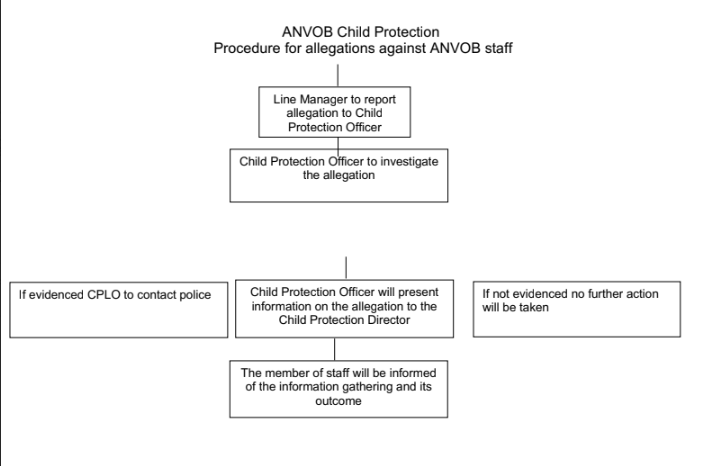
- ANVOB takes seriously any complaints made about the conduct of staff in respect of their contact with children and young people. All concerns received by the ANVOB will be investigated fully, and, if necessary, action will be taken against the member of staff via the disciplinary procedure.
- Dependant upon the facts presented to ANVOB about the complaint, ANVOB through the Chief Officer, will refer the matter to Essex Police.
- Support will be offered to all staff who are subject to an allegation. Where an investigation shows that the complaint against a member of staff was malicious, frivolous, or in any way unfounded, ANVOB will support the accused if the staff member wishes to pursue action against the complainant.
A chart has been added to this policy to assist staff to understand the complaints procedure of reporting child protection issues.
STAFF AND VOLUNTEER DECLARATION
The following are expected to sign their acceptance and understanding of this policy prior to undertaking any work or role relating to ANVOB:
- All Directors on the Board
- All volunteers aged 18 and over
- Any member of staff employed by ANVOB
February 2025
Reviewed by John Price